Updated: February, 24 2026
Author: Anna McClintock
Project Introduction:
I am creating an educational comic that explores how mistakes can become opportunities for creativity and learning. The story follows a student who feels frustrated after “ruining” a drawing and wants to quit. Through the guidance of an imaginative character (a crayon), the student learns to see mistakes as part of the creative process rather than as failure. I chose this topic because growth mindset and creative problem solving are essential ideas in both art education and classroom learning. Many students become discouraged when work does not match their expectations and I wanted to create a story that models a more supportive and realistic response to frustration.
This project is being developed individually, which gives me flexibility to experiment with pacing, panel structure and visual storytelling. My goal is to create a comic that feels accessible to elementary learners while still communicating a meaningful message about persistence and adaptability. I want readers to recognize their own experiences in the main character and understand that creative work often involves revision and transformation.
I am especially interested in how comics can teach emotional skills alongside artistic concepts. The format allows exaggerated expressions, humour and visual change to show how a mistake can evolve into something new. Throughout the process, I am paying attention to how layout, sequencing and imagery influence understanding. I see this project as both a design exercise and a pedagogical exploration of how storytelling can normalize struggle and encourage students to stay engaged in their learning.
THE PROCESS
Understand (Discover, Interpret, Specify)
Describe the Challenge:
Students often become frustrated when their work does not meet expectations and may give up, limiting opportunities for creative problem solving and growth mindset development.
Context and Audience:
The primary audience is elementary-aged students (ages 7–10) who are learning to manage frustration and develop persistence in creative tasks. Typically, these students have limited experience reframing mistakes as opportunities and may need explicit guidance and modeling.
Extreme cases include students who are highly perfectionistic or anxious about making mistakes, who might avoid creative tasks entirely. These learners require extra scaffolding to see that errors are part of learning rather than evidence of failure.
Motivations for the audience include curiosity, play and the desire to succeed or receive positive feedback. Students may have varying levels of confidence, self-regulation and previous experience with art or creative work. Behavioural factors include short attention spans, reliance on teacher direction and high sensitivity to perceived judgment.
The learning context includes classroom environments where students engage in visual arts, storytelling or project-based tasks. Accessibility considerations involve clear visual storytelling, concise text and character relatability, ensuring all students can engage regardless of literacy level or prior experience with art.
POV Statement:
An elementary student frustrated by mistakes needs guidance to reframe errors as opportunities so that they can build confidence, develop creative problem-solving skills and persist through challenges.
Learning Objectives:
- Primary Objective: Students will learn to approach mistakes as opportunities for exploration and adaptation.
- Sub-objectives:
- Recognize that errors are a natural part of learning.
- Experiment with alternative solutions after a perceived failure.
- Reflect on personal emotional responses to frustration.
- Promote interest in creative activities and meta-cognitive awareness of problem-solving strategies.
Plan (Ideate, Sketch, Elaborate)
Ideation:
Brainstorming included reviewing examples of educational comics and reflecting on classroom experiences. I sketched multiple ideas where characters interact with mistakes: a student alone, a student guided by a teacher and a student assisted by a talking art supply (pencil, brush or paint). The most promising prototype uses a talking crayon as a playful mentor, making abstract concepts accessible and visually engaging.
Storyboard / Script:
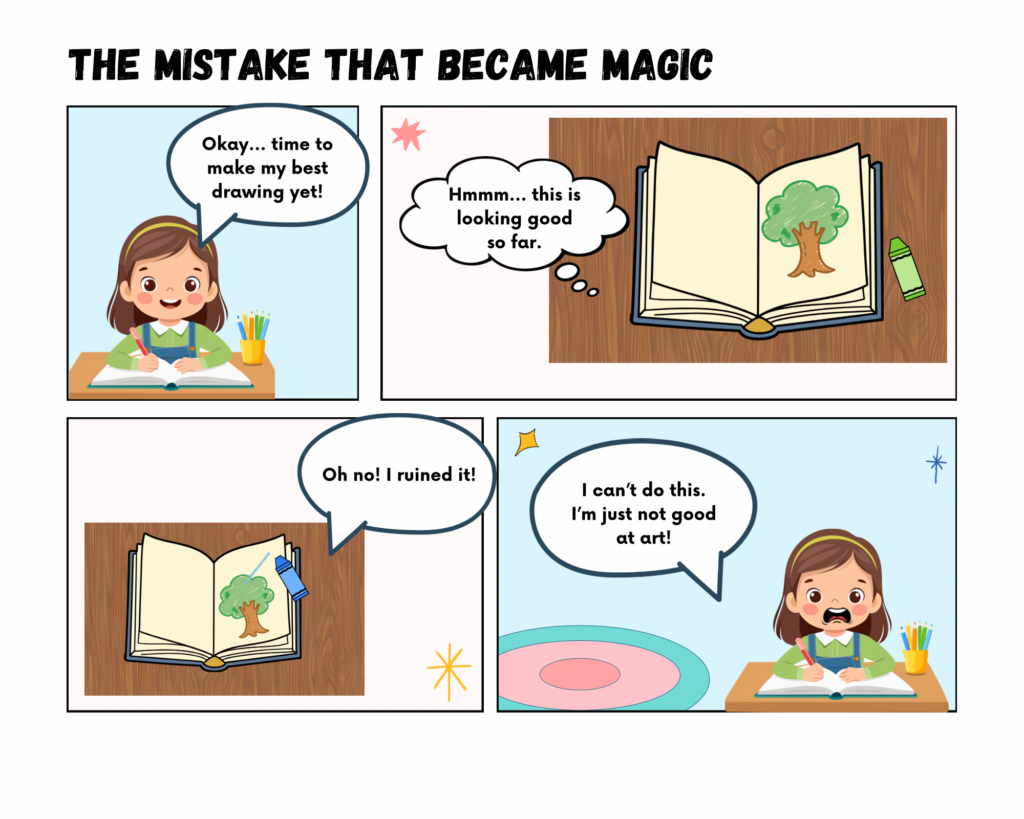
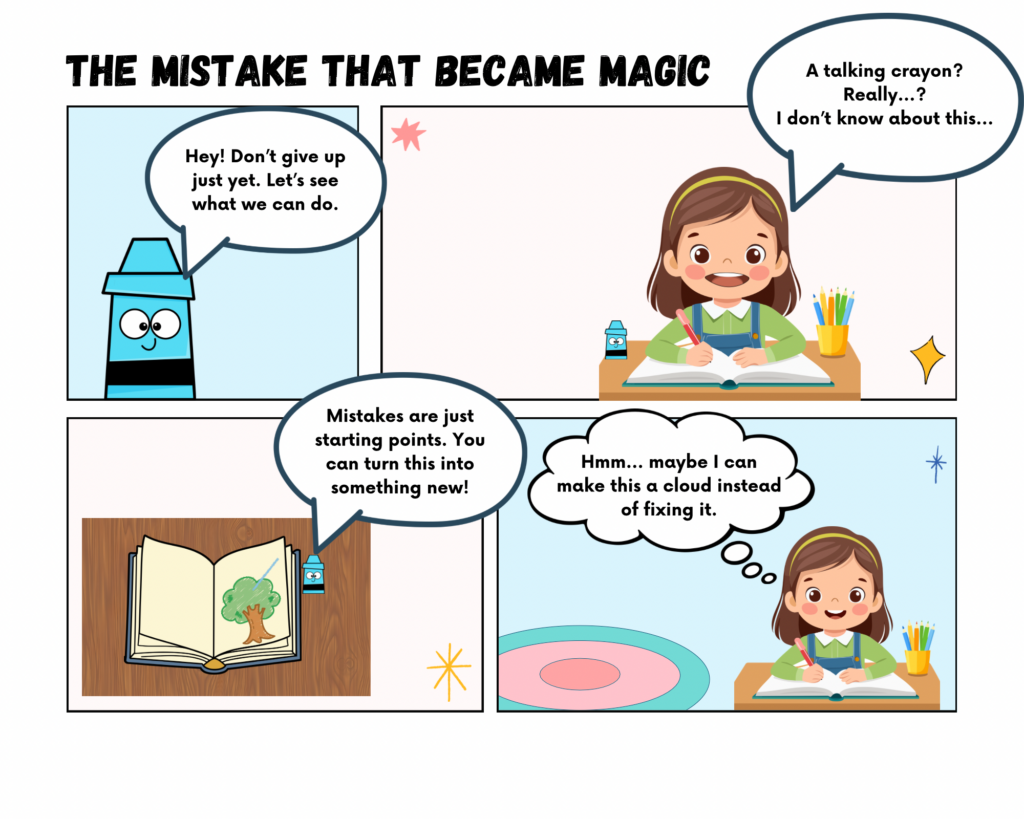
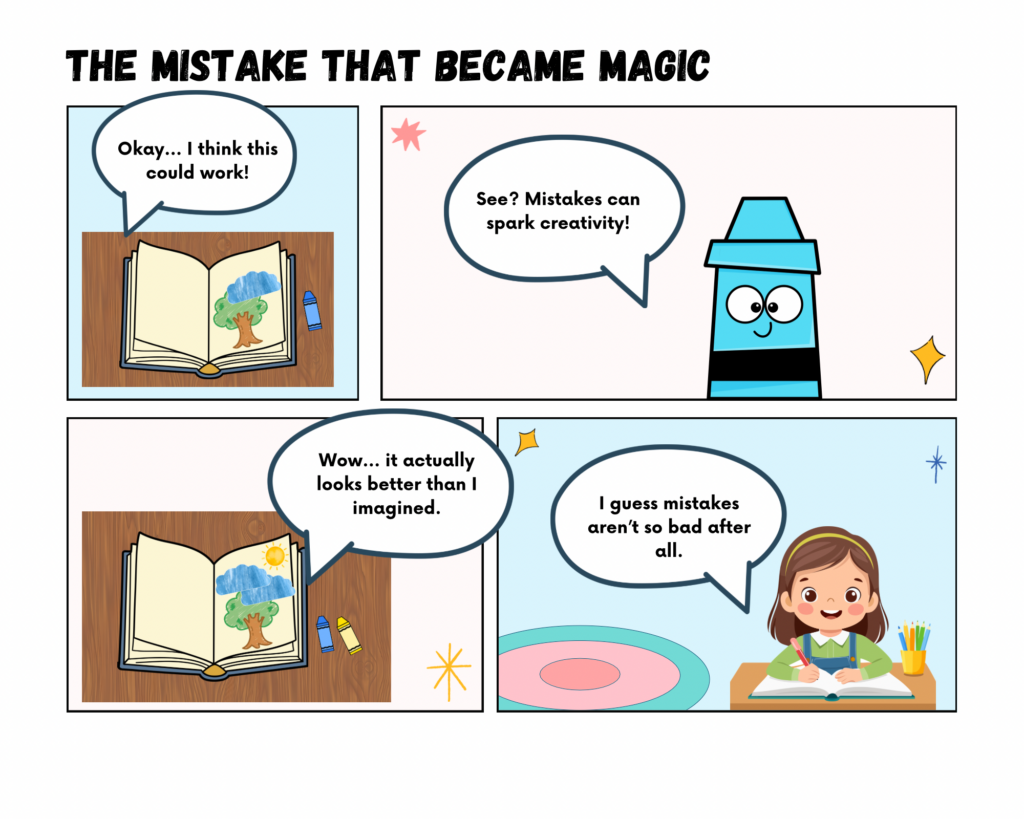
- 12 panels showing the student starting a drawing then making a “mistake” then getting frustration then a talking pencil appears then guided exploration of new ideas then a transformation of the mistake and lastly, pride in revised artwork.
- Panels include a mix of dialogue, thought bubbles and visual cues showing emotion and creative strategies.
Theory Applied:
- Growth Mindset (Dweck, 2006): Encourages students to see challenges and errors as opportunities for development. Used in the narrative by modeling persistence and reframing mistakes.
- Universal Design for Learning (UDL): Multiple means of representation (visual & textual), engagement (humor, relatable character) and expression (student can imagine applying strategies themselves).
- Multimedia Learning Principles (Mayer): Combining text and images to reduce cognitive load and support dual coding, making abstract ideas about mistakes tangible.
Prototype (Create & Share)
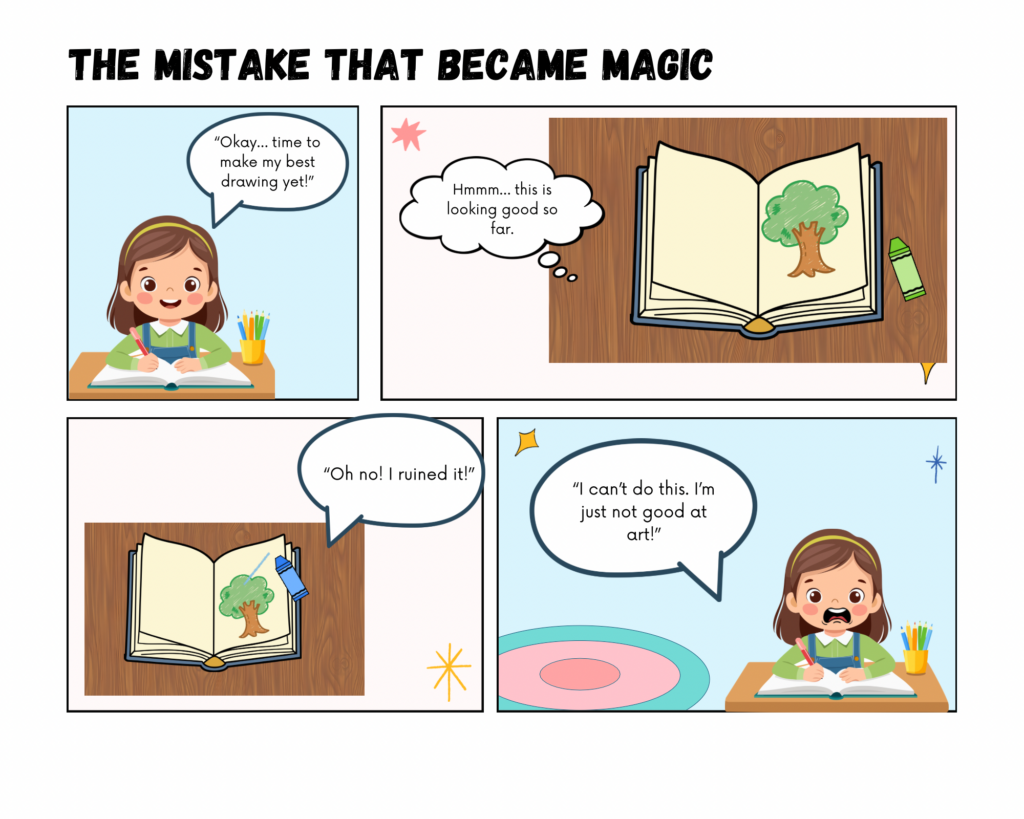
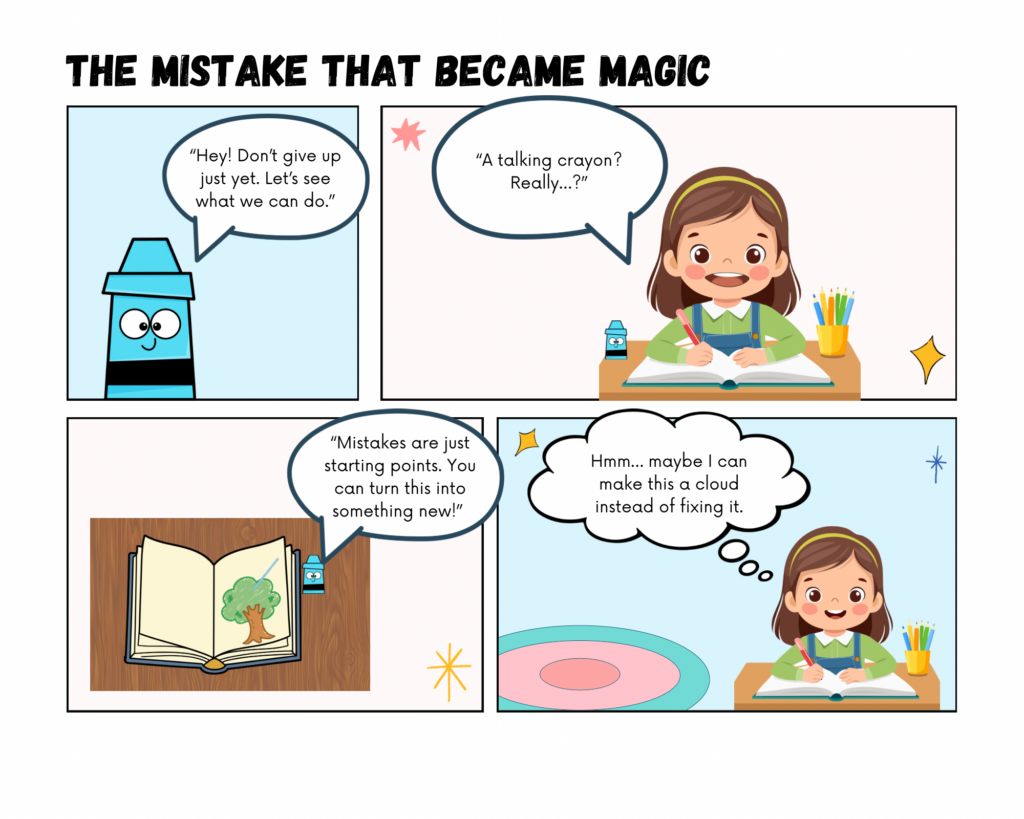
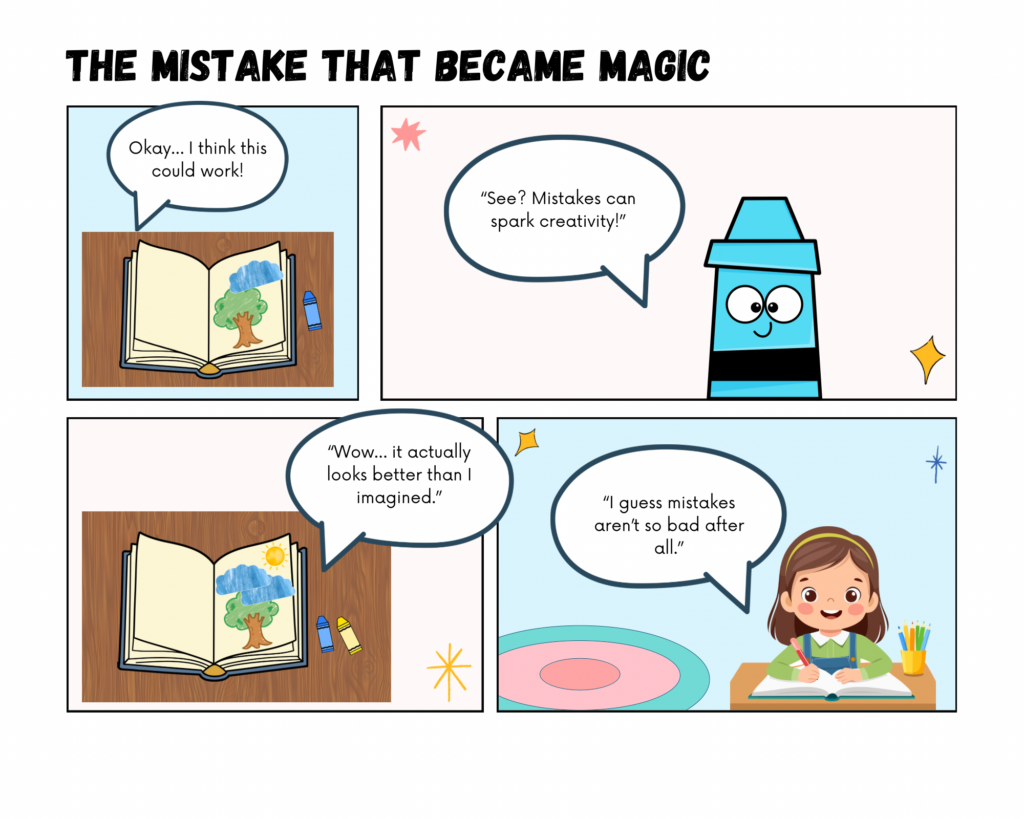
Comic Title: The Mistake that Became Magic
Peer Feedback
Across both peer responses, the feedback highlighted strong alignment between the concept, audience and theoretical frameworks. My peers noted that the comic clearly supports growth mindset principles by showing mistakes transforming rather than disappearing. They identified effective integration of UDL through visual storytelling, minimal text and accessible layout. Multimedia learning principles such as coherence, contiguity and signaling were also recognized. The personification of the crayon was described as developmentally appropriate and engaging for younger learners. My peers commented positively on the clarity of the images, the structured background, the strong POV statement and the focus on emotional safety, particularly in normalizing frustration and reducing pressure around mistakes.
One of my peers suggested that the emotional shift from frustration to acceptance may occur too quickly and recommended adding a panel that shows hesitation or resistance. There were also questions about how the comic could be more explicitly integrated into classroom practice, such as including a follow-up activity where students transform their own mistakes. Additional recommendations included clarifying key takeaways or assessment possibilities, considering an interactive element to support active learning, refining specific lines of dialogue and removing quotation marks from speech bubbles.
Accessibility and inclusion were also raised as areas for consideration. Feedback encouraged thinking about learners with disabilities who may require adaptations to begin creative tasks, as well as exploring options such as script highlighting for e-readers or larger, bolder fonts for visually impaired students. One of my peers questioned a background design choice in a specific panel and suggested considering visual consistency. Overall, both peers described the project as well-developed and theoretically grounded, with suggested refinements focused on emotional pacing, accessibility, classroom application and minor design adjustments.
Reflect and Refine
One aspect of the prototype that worked well was the strong alignment between intention, audience and theory. The comic clearly targeted younger elementary learners and intentionally reduced extraneous cognitive load through simple backgrounds, minimal text and consistent layout. Peer feedback affirmed that coherence, contiguity and signaling principles (Mayer, 2009) were evident in the pairing of dialogue and imagery. The personification of the crayon also supported emotional accessibility, offering learners a psychologically safe entry point into the concept of mistakes. By visually transforming the mistake rather than erasing it, the prototype embodied growth mindset principles (Dweck, 2006) in both language and design. The structured sequencing from frustration to experimentation mirrored authentic classroom experiences and supported emotional normalization, which aligns with research on affect and learning.
However, peer feedback highlighted that the emotional shift may occur too quickly for some learners. In response, I recognized that authentic emotional processing is not always linear. To address this, I revised the prototype by adding to a speech bubble where the learner hesitates and questions the crayon’s suggestion slightly. This adjustment validates resistance and reflects more realistic emotional pacing. I also revised specific dialogue for clarity and encouragement, removed quotation marks from speech bubbles for visual consistency and adjusted font size and boldness so it is all cohesive. These revisions strengthen narrative authenticity while preserving cognitive clarity.
Another issue raised involved classroom integration and assessment. While the prototype centered primarily on mindset development, peer feedback encouraged me to think more explicitly about how the comic could function instructionally. I reflected on how the comic might naturally extend into classroom dialogue or follow-up opportunities. This process helped me recognize the importance of connecting design intentions to active learning principles, even if those extensions are not fully developed within the prototype itself. It also prompted me to clarify the intended takeaway: that mistakes are iterative starting points in both creative and academic processes.
Peers also raised important considerations around inclusion, particularly for learners who may require additional support to begin creative tasks. This feedback led me to reflect more deeply on the affordances and constraints of multimedia learning. While the comic format can reduce extraneous cognitive load and support dual coding through image to text pairing (Mayer, 2009), it cannot independently meet all learner needs. Universal Design for Learning principles (CAST, 2018) remind us that accessibility and differentiation require ongoing teacher responsiveness. As a result, I began thinking more critically about how this prototype would operate within a broader instructional context rather than as a standalone tool.
Overall, this process reinforced that multimedia learning tools must balance clarity with emotional depth. The comic format is powerful for modeling internal dialogue, visualizing abstract concepts and reducing performance pressure. At the same time, its limitations include pacing constraints, accessibility considerations and reliance on teacher implementation for deeper transfer. The peer feedback strengthened the prototype by pushing me to deepen emotional realism, expand active engagement and consider broader inclusion. This iterative revision process reflects the very mindset the comic promotes: design, test, reflect and refine.
Final Artifact